
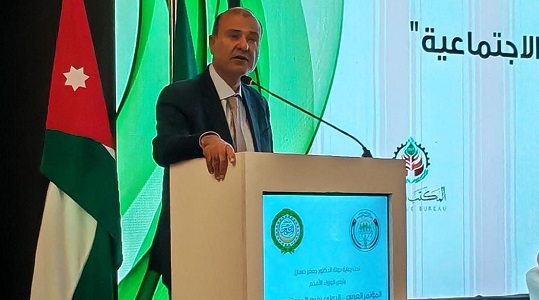
The Secretary General of the Union of Arab Chambers, Dr. Khaled Hanafy, reviewed, during a speech delivered at the high-level Arab conference on “Implementing the Declaration Issued by the Second World Summit for Social Development”, held as part of the 45th session of the Council of Arab Ministers of Social Affairs convened in Amman, Hashemite Kingdom of Jordan, “the role of the private sector in strengthening Arab partnerships to implement the objectives of the Doha Declaration in the field of social development”. The conference was attended by the Prime Minister of Jordan, Dr. Jaafar Hassan, the Secretary General of the League of Arab States, Ahmed Aboul Gheit, Arab and foreign ministers of social affairs, as well as a group of Arab and international decision-makers and experts. He stated that “the Doha Declaration is excellent and requires implementation decisions so that no one is left behind. This requires strengthening inclusion, not only financial or economic inclusion, but comprehensive inclusion and integration to create a productive society driven by the determination and will of all segments of society”.
He considered that the social challenges facing our region are no longer limited to poverty, unemployment, or the weakness of social protection systems. Rather, we are facing a new phase in which economic, social, and technological factors overlap, which obliges us to think differently and to reformulate the approach through which we deal with social development.
He noted that the “Doha Declaration” has placed before us an ambitious roadmap, reaffirming that social development is not a complementary item within public policies, but rather the main engine upon which strong economies and stable societies are built. He considered that the success of the “Doha Declaration” will not be achieved if we treat it as a traditional document. What is required today is a new vision that brings together the economy and the human being, and opens the door to solutions different from those we are accustomed to.
He considered that “the traditional approach to social policies, based on subsidies, transfers, and aid, is no longer sufficient. In a rapidly changing world, we need an approach based on proactive rather than reactive policies. Accordingly, there must be a system capable of anticipating social challenges before they escalate, using data and early signals of changes in labor markets, price levels, and social gaps. There must also be adaptable social protection networks, as flexibility is the key word in the new century. Therefore, social protection systems should automatically expand during crises and contract during periods of stability, covering everyone, including non-regular workers and informal sectors. The social dimension must also be integrated into economic development, because any economic plan that does not integrate human empowerment will not be able to endure. Hence, we need legislation that incentivizes companies to promote decent employment, skills development, and adherence to environmental, social, and governance standards. With this new vision, the implementation of the Doha Declaration becomes a strategic project rather than merely a political commitment”.
He noted that “the Union of Arab Chambers represents a sector comprising millions of companies, and it is ready for broader roles in implementing the Doha Declaration. To make the role of the private sector more impactful, we propose three practical and innovative tracks. The first track is based on launching an Arab platform for sustainable social finance that brings together governments, the private sector, and financial institutions to finance projects with social impact. The second track is through an Arab program for socially inclusive supply chains. The third track is through launching a ‘Social Skills Visa’, an initiative through which the private sector grants training or employment opportunities to youth based on a simple criterion, the possession of social and professional skills capable of growth, not only academic degrees. This idea supports social integration and opens doors to employment for broad segments of society”.
The Secretary General of the Union, Dr. Khaled Hanafy, proposed that “to transform the declaration into tangible results, we need applicable steps that bring together the social and economic dimensions, such as a unified Arab map for multidimensional poverty, an Arab charter to align social policies with digital transformations, more flexible social protection networks, and a social-developmental economy”.
He considered that, to transform the declaration from recommendations into tangible results, a three-level Arab pathway is required, the first at the national level, the second at the regional level, and the third at the international level. He called, at the conclusion of his speech, for the establishment of a permanent Arab mechanism for social development, “because our commitment to the Doha Declaration is a commitment to a more balanced and just future. In a world full of challenges, we need bold social policies, an economy that places the human being at its center, and partnerships that build on the capacities of all. Therefore, we propose the establishment of an ‘Arab Council for Social and Economic Development’ to follow up on the implementation of the declaration, coordinate efforts among various parties, and measure impact on an annual basis. The Union of Arab Chambers is committed to being an active partner in this process, so that social action becomes part of the equation of economic advancement in our region”.
In an intervention by the Secretary General of the Union on the Arab Index for Social Responsibility, within the work of the 45th session of the Council of Arab Ministers of Social Affairs, he considered that the meeting represents a pivotal milestone for strengthening joint Arab social action and building on the pioneering efforts of the Council of Arab Ministers of Social Affairs, in order to consolidate an advanced Arab vision for more effective institutional responsibility, more closely linked to sustainability and development priorities.
He explained that what is being proposed today through the Arab Index for Social Responsibility is a strategic step to build an integrated Arab institutional transformation that combines the economic, social, and governance dimensions, and leads toward a new pattern of institutional work based on transparency, measurability, and sustainable impact.
He considered that the Arab Index for Social Responsibility is a unified Arab framework that helps institutions, whether companies or non-profit entities, assess their performance in environmental, social, and governance aspects. It has been designed to provide a clear picture of the level of institutional commitment, through a final score ranging from zero to one hundred, according to a transparent methodology and internationally recognized standards.
He clarified that the Arab Index for Social Responsibility is the result of joint cooperation between the Union of Arab Chambers, the League of Arab States, and the international HOPE Foundation, within a partnership aimed at enhancing institutional performance and linking the Arab business sector to global standards for environmental, social, and governance responsibility, within the framework of a unified Arab system.
This cooperation aims to transform commitments into tangible results, and principles into measurable outputs, thereby contributing to the consolidation of a culture of institutional responsibility in the Arab region.
Dr. Khaled Hanafy noted that joining this index grants institutions important practical benefits, including enhancing reputation among society and investors, improving the level of transparency within the institution, attracting investments concerned with sustainability and institutional responsibility, building new local and international partnerships, and obtaining objective analysis that helps develop future plans.
He concluded by stating that Arab society today needs strong, transparent institutions capable of creating real social impact. This index represents an important step along a long path toward strengthening social responsibility in the Arab world. Care has been taken to ensure that it is practical, simplified, and of real benefit to every institution seeking to improve its performance.
Source (Union of Arab Chambers)
